
Reviewed · BELGRADE TOURS
Belgrade: The White Emigration in Serbia in the Wake of the Russian Revolution
The Russian Revolution sent up to two million people into exile, and as many as 100,000 reached the Kingdom of Serbs, Croats and Slovenes. This walking tour shows how that sudden arrival changed Belgrade, from Baron Wrangel’s grave and Russian architects to ballet, science, cafés, and the unusual army Serbia agreed to host.
I like two things here: the subject is specific rather than a general city overview, and the route connects politics with ordinary life, including Hotel Moskva’s old cake recipes. The drawback is the price, $173.64 per person for about three hours, so this makes the most sense for a private group with a strong interest in Russian and Serbian history.
Key points at a glance
- A White Emigration story in seven central Belgrade stops: Follow Russian exile history through churches, government buildings, royal sites, theaters, cafés, universities, and squares.
- Guide Julja brings the subject to life: Her Serbian history background and animated explanations are central to the experience.
- Baron Wrangel’s final resting place: Visit Holy Trinity Church, where the White Army commander is buried.
- Russian influence beyond politics: See how Russian architects, scientists, dancers, designers, and performers shaped Belgrade.
- A coffee stop with historical flavor: At Hotel Moskva, try the Moskva and Aurora cakes, made from recipes said to be half a century old.
- A private three-hour walk: Only your group participates, with a guide included and food and drinks paid separately.
Why Belgrade became a refuge after the Russian Revolution
This tour begins with a question that gives the whole walk its purpose: why did so many Russian emigrants settle here?
After the Bolshevik Revolution, roughly one to two million people left Russia over a period of three years. Up to 100,000 found their way to the Kingdom of Serbs, Croats and Slovenes, a substantial arrival for a country with a much smaller population than the great powers of Europe.
You will look at this movement not simply as a story of refugees passing through. The Russian community brought professional skills, artistic traditions, political complications, and a trained military force into a country that had to decide how much help it could give without creating a new problem.
That last point is one of the tour’s most unusual subjects. Serbia hosted a fully trained, and partly armed, army belonging to another country. You will consider how such an army could exist in exile without overthrowing a government, taking territory, or running out of food. It is a practical question, not just a military footnote.
Guide Julja is especially important here. The tour depends on connecting Serbian history with the Russian story, and her role includes answering questions about both. One of the strongest impressions from the experience is the sense that you are looking at Belgrade through the eyes of people trying to build a new life after losing their old one.
A few more days out around Belgrade to weigh up
- Northern Serbia: Sremski Karlovci and Novi Sad Full-Day Tour from Belgrade
★ 5.0 · 425 reviews - Day Trip from Belgrade: Gems of Eastern Serbia
★ 5.0 · 424 reviews - Belgrade Nightlife Bar Pub Club Crawl with Drinks
★ 5.0 · 277 reviews
Holy Trinity Church and Baron Wrangel
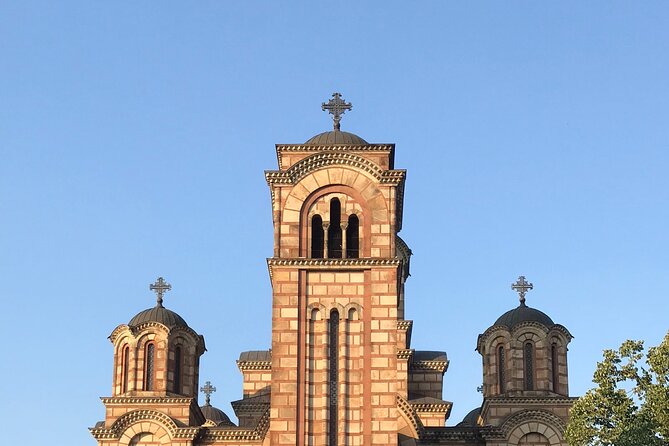
The walk begins at St. Mark Orthodox Church on Bulevar kralja Aleksandra 17. From there, you walk to Holy Trinity Church, the Russian church associated with the émigré community.
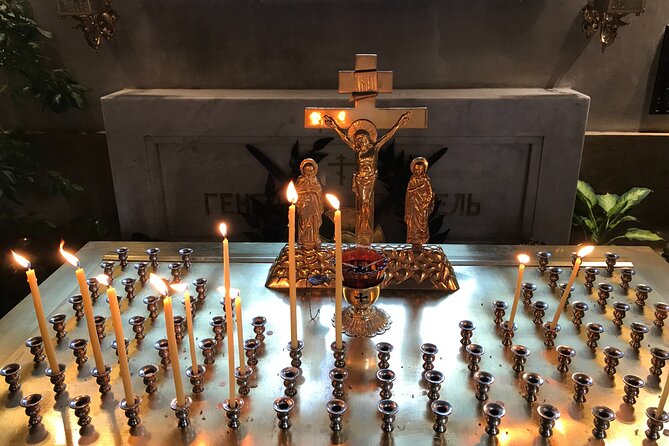
The stop lasts about 30 minutes and admission is free. Its main historical focus is Baron Pyotr Wrangel, the White Army commander buried there. Wrangel is often remembered as the Black Baron, a figure from the anti-Bolshevik forces who became one of the most recognizable military leaders of the Russian Civil War.
Seeing his burial place gives the political story a physical anchor. Instead of treating the White Emigration as an abstract movement of numbers, you encounter the memory of a man who represented an army, a defeated cause, and a community living far from home.
I would pay close attention to the way the church functions in the story. It is not only a religious building. It also points to the institutions Russian emigrants needed to preserve identity, mark important lives, and maintain links with one another.
The tour does not charge admission at this stop, but you should expect a walking visit rather than a long indoor program. Comfortable shoes are sensible because the experience moves through several central districts on foot.
A Russian imprint among Belgrade’s public buildings
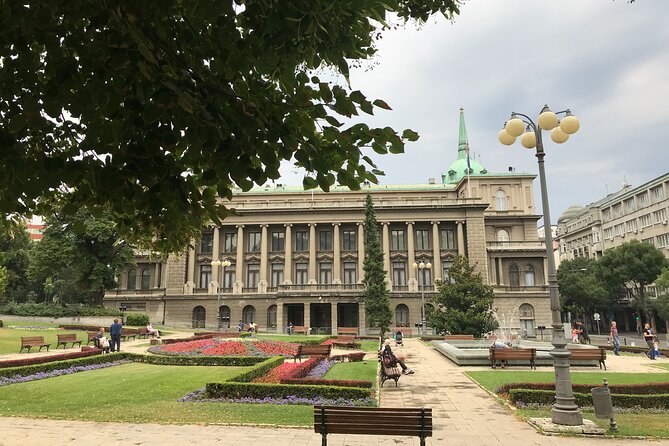
The next section leads through a picturesque former royal park and past major state buildings. You will see the Serbian Parliament, the post office, the General Staff, and ministries while looking for Russian contributions to Belgrade’s architecture.
This part is useful because it widens the story. Russian influence was not limited to churches, monuments, or private homes. Russian architects helped shape the official face of the capital, including buildings connected with government and public life.
The tour also asks why that contribution is not always acknowledged in a straightforward way. That question adds some welcome caution. National architecture is rarely the work of one country alone, and political memory can affect whose role gets highlighted. You will be encouraged to look carefully rather than simply label every grand building as Russian.
The timing is about 30 minutes. You will be outdoors and moving, with the guide explaining the buildings as part of the wider city. If your main interest is architecture, this may be one of the most valuable portions of the walk, since it links visible details to the political circumstances that brought Russian professionals to Belgrade.
Royal Palaces and Nicholas II’s Serbian connection
The route continues past the Royal Palaces and a monument to Nicholas II. Here, the focus shifts from exile and public administration to the relationship between the Russian and Serbian dynasties.
That connection helps explain why Serbia was willing to receive so many Russian émigrés. The story was not built only on practical needs or humanitarian concern. Dynastic ties, Orthodox connections, and political sympathy also mattered.
You will spend about 30 minutes on this section. It is a useful counterweight to the military story because it shows the Russian presence from the viewpoint of rulers and state relationships. The monument to Nicholas II provides a clear stopping point, while the Royal Palaces place the discussion in the setting of Serbia’s former monarchy.
I like this part because it shows how personal and family ties can shape national decisions. At the same time, you should expect discussion rather than palace entry. The route passes by the royal sites, so the appeal lies in the historical explanation and exterior views.
Same city, a completely different day out:
- Taxi to/from Belgrade Airport to/from Belgrade City Center
★ 5.0 · 241 reviews - Belgrade Big Tour: Top Attractions and Belgrade Neighborhoods
★ 5.0 · 232 reviews - From Belgrade: Golubac Fortress & Iron Gate Danube Gorge
★ 4.8 · 185 reviews - Along the Danube: Golubac Fortress & Iron Gate Gorge day trip from Belgrade
★ 4.5 · 185 reviews
Hotel Moskva, old recipes, and Belgrade society
Hotel Moskva is the tour’s most relaxed stop. After walking through a street once filled with craft workshops and now associated with designers, you enter the hotel’s luxurious interiors for coffee.
You can try two cakes, the Moskva and the Aurora, prepared according to recipes that are about half a century old. Food is not included in the tour price, and alcoholic drinks and snacks are also excluded, so plan to pay separately for anything you order.
This stop matters because it brings the subject down to everyday life. Russian émigrés were not only soldiers, architects, professors, and political figures. They also took part in the social life of Belgrade, in the places where people met, worked, displayed taste, and watched the city’s well-dressed society.
The visit lasts about 15 minutes, which is short. You should not expect a long café break or a full meal. Still, a brief stop at Hotel Moskva gives the walk a pleasant change of pace and lets you connect history with food and public life.
The cake names are also a practical detail. If you enjoy food history, this is likely to be one of the most memorable moments. If you prefer a strictly political tour, the stop may feel lighter, but it gives the three-hour walk some welcome variety.
Russian ballet and music at the National Theatre
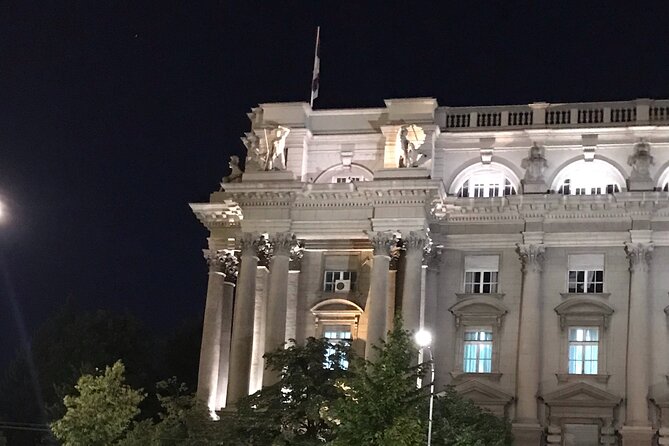
At the National Theatre, the Russian contribution becomes artistic. Russian ballerinas performed here, while scenic designers, choreographers, and directors worked in Belgrade.
The stop takes about 15 minutes. That may sound brief, but it fits the tour’s wider method: you visit a place, identify its Russian connection, and move on to the next part of the story.
You will also hear about street songs and learn who deserves kind remembrance when you hear a Serbian choir sing. This detail suggests that the Russian influence was not confined to elite stages. Music could cross from professional performance into public sound and shared culture.
I appreciate the way this stop connects several kinds of artistic work. Ballet is the obvious subject, but scenic design and directing matter too. The result is a fuller picture of how émigré professionals contributed behind the scenes as well as in front of an audience.
As with the royal sites, the listed experience is a walk to the National Theatre, not a performance or backstage visit. You should book this for the historical explanation, not for guaranteed access to a show.
University and the Serbian Academy of Sciences and Arts
The route then takes you to Belgrade University and the Serbian Academy of Sciences and Arts. Here, the subject is the fate of emigrant scientists.
This is an important stop because military and artistic stories often dominate accounts of exile. Scientists faced their own problems: they had to find work, continue research, adapt to a new academic system, and decide how much of their professional life could be rebuilt in a foreign country.
The visit lasts about 30 minutes. You will see the institutions connected with scholarship while considering how Russian academics fitted into Serbian intellectual life.
This section should appeal to anyone interested in universities, science, or the practical side of starting again. It also reinforces one of the tour’s main ideas: the Russian community left a mark in many fields, not just in monuments that are easy to photograph.
You may find this part more discussion-heavy than visually dramatic. That is not a flaw, but it is worth knowing before you book. The value comes from the explanation of careers and institutions rather than from a single famous object.
Gavrilo Princip Square and the final walk through Nemanjina
The final section takes place around Nemanjina and includes a visit to Gavrilo Princip Square. The discussion turns to the First World War and the role of the assassination associated with Princip in world history.
This is a fitting close because the Russian émigré story cannot be separated from the upheavals of the early 20th century. The First World War helped create the political conditions that followed, and those conditions led to revolution, civil war, exile, and the reshaping of European states.
You will also visit places Russian emigrants used a century ago, locations that still exist and remain open to the public. That detail adds a strong sense of continuity. The walk is not only about what disappeared. It also traces places that you can still encounter in present-day Belgrade.
The section lasts roughly 30 minutes. Since the tour ends back at the meeting point, the route forms a complete loop in practical terms, beginning and ending near St. Mark Orthodox Church.
What the $173.64 price means
At $173.64 per person, this is an expensive walking tour compared with a standard large-group city walk. The price needs to be judged against its format: it is a private activity, only your group participates, and a guide is included.
That private format can offer real value if you are traveling with family or friends who share an interest in Russian, Serbian, military, architectural, or cultural history. Group discounts are available, which may make the cost easier to justify for a larger party.
The tour is about three hours long. You are paying for a focused subject and a guide who can connect seven stops into one narrative, not for entrance tickets. The stops are listed as free admission, while coffee, cakes, snacks, and alcoholic drinks cost extra.
I would not book this simply because you want to see Belgrade’s headline sights. The route includes important public buildings, royal locations, the National Theatre, and academic institutions, but the real product is the interpretation. The value depends on how much you want to understand the Russian presence behind those places.
Who should book this Belgrade walk?
I would recommend it to you if you enjoy a city tour built around one historical question. It suits people interested in the Russian Civil War, monarchies, Orthodox connections, exile communities, military history, architecture, theater, music, or science.
It is also a strong choice if you have already seen central Belgrade and want a more specialized way to read the city. The route gives familiar buildings a different meaning and encourages you to notice Russian links that a general sightseeing walk may skip.
Families can enjoy it too, especially if the group likes asking questions. Julja’s ability to handle detailed questions is one of the tour’s key strengths, and the private setup lets the pace and conversation stay within your group.
You might want another experience if you need extensive indoor sightseeing, museum entry, or a relaxed café visit. Several stops last only 15 or 30 minutes, and the walk focuses on exteriors and explanation. You should also factor in the full cost of refreshments and the relatively high per-person price.
Free cancellation is available if you cancel at least 24 hours before the local start time. Changes or cancellations inside that window are not accepted for a refund.
Should you book The White Emigration in Serbia?
Book it if you want to understand how a defeated Russian army, displaced professionals, artists, scientists, and aristocratic connections became part of Belgrade’s public life. The tour gives you more than a list of Russian buildings. It asks how a small country managed a large and complicated arrival, then follows the results through churches, government, royalty, food, performance, and scholarship.
The main caution is cost. At $173.64 per person, this is best shared with a group and chosen for its specialist subject. If that subject grabs you, the private format and guide Julja’s detailed, animated approach can make the price worthwhile. If you want only broad sightseeing, choose a less specialized walk.
FAQ
Where does the tour begin?
The tour begins at St. Mark Orthodox Church, Bulevar kralja Aleksandra 17, Belgrade, Serbia.
Where does the tour end?
The activity ends back at the meeting point.
How long does the experience last?
The tour lasts approximately three hours.
Is this a private tour?
Yes. Only your group participates in the activity.
Are admission tickets included?
The listed stops have free admission. A guide is included, but food and drinks are not.
Can I cancel for a full refund?
Yes, if you cancel at least 24 hours before the experience start time. Cancellations or changes made less than 24 hours before the start time are not accepted for a refund.
Just added around Belgrade
- Private Walking Tour of Belgrade and Old Zemun★ 5.0 · 3 reviews
- Feel Belgrade Welcome tour★ 4.5 · 3 reviews
- From Belgrade: Danube Day Trip with Wine and Brandy Tasting★ 5.0 · 3 reviews
- Private Half Day Serbia Tour Novi Sad and Petrovaradin Fortress★ 5.0 · 3 reviews
- Private Wine Tasting by Party in Belgrade★ 5.0 · 3 reviews
- Zica and Studenica monastery From Belgrade★ 5.0 · 3 reviews
- Belgrade Fashion and Design Tour – Discover Local Designers★ 5.0 · 4 reviews
- E-Scooter Serbian Food Tour★ 5.0 · 3 reviews
Belgrade Tours, compared.
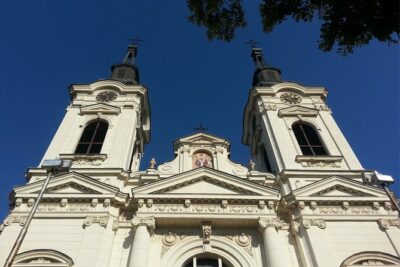
Northern Serbia: Sremski Karlovci and Novi Sad Full-Day Tour from Belgrade
Read our review →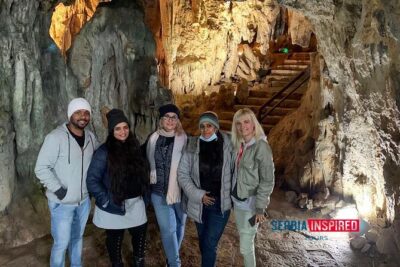
Day Trip from Belgrade: Gems of Eastern Serbia
Read our review →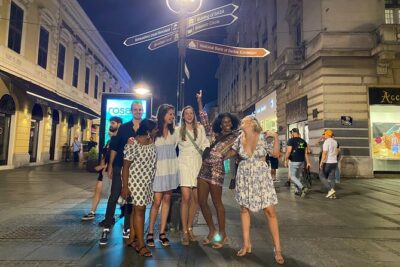
Belgrade Nightlife Bar Pub Club Crawl with Drinks
Read our review →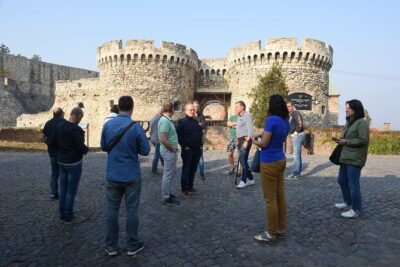
Belgrade Big Tour: Top Attractions and Belgrade Neighborhoods
Read our review →
Along the Danube: Golubac Fortress & Iron Gate Gorge day trip from Belgrade
Read our review →
Belgrade Underground Tour w/ Sparkling Wine Along the River
Read our review →Browse the lists this tour appears in